

 Car service & maintenance: How to adjust your tyre pressures.
Keeping your tyres at the right pressure is a key part of car care that’s easy to forget. The right pressure not only boosts your car’s performance and fuel economy but also plays a big role in keeping you safe while driving. We often see underinflated tyres in our Southampton car service centre usually accompanied by a TPMS light. Luckily, this is usually an easy five minute fix. In this guide, we will walk you through the steps to accurately check and adjust your tyre pressures.
Why is tyre pressure important?
Tyre pressure affects various aspects of your driving experience, including:
- Safety: Properly inflated tyres provide optimal grip, improving your vehicle's stability, handling, and braking capabilities.
- Fuel Efficiency: Underinflated tyres can lead to increased rolling resistance, causing your vehicle to consume more fuel.
- Tyre Lifespan: Maintaining the correct tyre pressure helps ensure even tire wear, extending the life of your tyres and saving you money in the long run.

There are two main places where you will be carrying out your adjustments. If you have a tyre pump available at home you can do this on the driveway, if not head to your nearest petrol station which will usually have a tyre pressure machine. For this guide we will be focusing on using the machines at petrol stations but you can still follow along using a pump at home.
Step-by-Step Guide to Adjusting Your Tyre Pressures
1. Check the recommended tyre pressure
Before you can adjust your tyre pressures you need to know what numbers to follow. You can often find your vehicle’s recommended tyre pressures on a sticker (pictured) in the door sills or petrol cap of your vehicle. If not you can always consult your owners manual or Google.
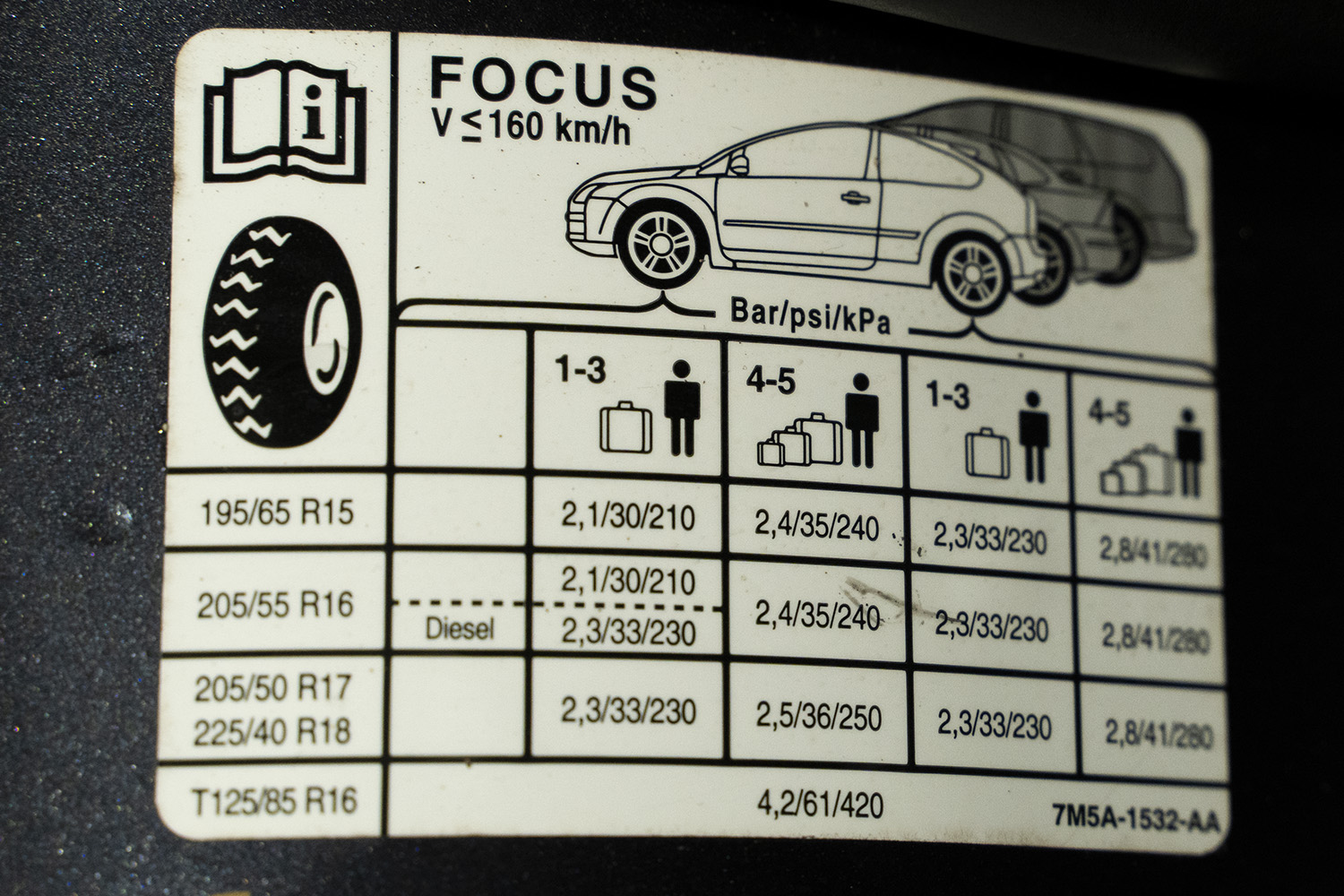
It is important to note your tyre size when adjusting tyre pressures. Your tyre size is found on your sidewall and displayed in an XXX/XX RXX format. Once you have your tyre size you can use the information sticker (or owners manual) as a reference point.
In the image above which has been taken from a Ford Focus you can see various options which can be confusing at first. These are however fairly easy to understand. Lets assume this car has 225/40 R18 tyres and is being used for normal day-to-day commuting. We can see on the chart that the car requires 2.3 Bar or 33 PSI for the front tyres and again for the rear tyres.
If we were to be taking the whole family on holiday with extra luggage we can see that the car would require 2.5 Bar or 36 PSI in the front tyres and 2.8 Bar or 41 PSI in the rear. This is because of the extra weight being carried by the tyres.
2. Set up the Air Compressor or pump.
If you are using your own tyre pressure pump for the following steps your process may vary but the principle remains the same.
- Park close to the pump and exit your vehicle.
- Put your money into the machine if required (usually 50p or £1 for 5 mins of air)
- Adjust the digital display screen to your desired pressure.
3. Adjust your tyre pressures
- Remove the valve cap from the tyre.
- Attach the air hose securely to the valve stem.
- The digital display will show the current tyre pressure.
- If the pressure is lower than recommended, the machine will automatically add air until the desired level is reached.
- Wait until the machine stops and signals completion. This is usually a beeping sound.
- Detach the hose quickly and replace the valve cap.
Repeat for all tyres
Move around the vehicle and repeat the process for each tyre, ensuring all are inflated to their correct pressures. You may also want to check your spare tyre is inflated if you have the time.

Tips for maintaining tyre pressure:
- Check Regularly: Aim to check your tyre pressure at least once a month and before long trips. This can help with unnecessary wear and reduce the chance of car repairs being needed.
- Check When Cold: Tyre pressure readings are most accurate when the tyres are cold (driven for less than a mile).
- Follow Manufacturer's Recommendations: Refer to your vehicle's manual or the tyre placard for the recommended tire pressure.
- Check Spare Tyre: Don't forget to check the spare tyre periodically. It's often overlooked but crucial in emergencies. In the sticker shown earlier the pressures for the spare are displayed at the bottom next to T125/85R16.
Why are my tyre pressures dropping?
Your tyre pressures can change for a variety of reasons. Here are the most common ones;
- Damaged tyre: Your tyre could have a puncture or slow air leak which will drop the pressures.
- Parking angle: If you often park at an angle (one side higher than the other on a kerb for example) you may find tyre pressures drop on the side carrying more weight.
- Time: Your tyre pressures can drop over time especially if you are leaving your car stationary for long periods of time.
- Temperature changes: sudden cold snaps or heat waves can bring on a change in your tyre pressures.
What does a TPMS light look like?
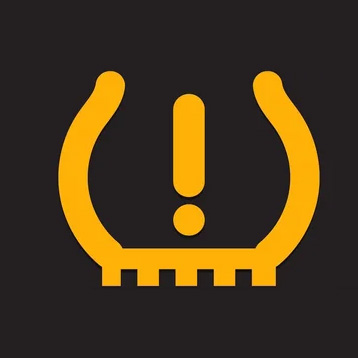
In modern cars you will likely have a TPMS (tyre pressure monitoring sensor) in each of your wheels that monitors your tyre pressures. When a change is detected in any wheel you will see a TPMS warning light on your dash. It will usually look like the one pictured below or similar. TPMS are notoriously troublesome and may not always mean a fault is present. It should be taken as a reminder to check and adjust your pressures as soon as possible. If you have adjusted your pressures and the light persists you may have a faulty sensor or need to follow a reset procedure found in your owners manual.
We hope you found this guide useful and are always happy to help with all of your vehicle related issues at E&J Jarvis LTD.





 Spidersnet